How to Pick March Madness Winners: 7 Perennial Attributes

By Sascha Paruk
Updated:
Verified by: Patrick Cwiklinski
- Experienced coaches, senior-led rosters and strong guard play continue to define March Madness winners
- Advanced stats have proven to be great predictors of tournament success
- Defensive efficiency might be the most important statistic, historically, when identifying your NCAA Tournament champ
Anyone who has ever filled out a March Madness bracket knows just how fickle the NCAA Tournament can be. Every year, some tiny college from a town you’ve never heard of becomes the belle of the ball by knocking off a powerhouse. These Cinderella squads break up brackets, cost bettors millions, and make talking heads look foolish on TV.
Picking NCAA Tournament Winners
Although picking a perfect bracket is nigh impossible, picking the champion is not. We’ve analyzed every Division I Men’s NCAA championship team from 2010 to 2025 and have found they have a lot in common.
This article details their many similarities and gives you a checklist for picking future tournament winners at the best March Madness betting apps.
1. March Madness Champions Rely on Upperclassmen
It’s nice having five-star freshmen, but you can’t expect them to do all the heavy lifting. Every NCAA championship team from the past 15 years has had multiple upperclassmen who were vital to their team’s success.
The 2023 UConn Huskies almost bucked the trend: leading scorer Adama Sanogo was a junior and Tristen Newton was a senior, but their other top-five scorers were all freshmen. With NIL and the Transfer Portal starting to take over, one could see how things were perhaps about to change.
Not so much.
When the Huskies repeated in 2024, sophomore Donovan Clingan was certainly a major part of it, but it was grad students Newton and Cam Spencer that were leading the way.
In 2025, Florida’s top three scorers, Walter Clayton Jr., Alijah Martin and Will Richard, were all seniors.
Upperclassmen know the system, are less likely to get rattled by the bright lights, and are generally more physically and emotionally mature than freshmen. That counts for a lot when you’re playing against 18-year-olds.
2. March Madness Champions Are Guided by Proven Coaches
The last 15 NCAA championships have been won by 11 different coaches and all but four had a Hall of Fame-caliber resume at the time they won. The obvious exception is Kevin Ollie, who was promoted to head coach at UConn in 2012 following the retirement of Jim Calhoun, and won a championship two years later. Ollie did an exceptional job guiding his team, but Calhoun deserves plenty of credit for assembling the talented roster that Ollie inherited.
Taking Ollie out of the equation for a moment, seven of the remaining ten coaches all had at least 24 years of head-coaching experience, over 500 career victories, and a lifetime winning percentage above 64.0% at the time they won. The others were Tony Bennett (Virginia, 2019), who had a lifetime winning percentage of 72.5% at the time of his title (323-122), Scott Drew (Baylor, 2021), who was at 64.4%, and Dan Hurley (UConn, 2023 and 2024) who was 255-160 (61.4%) when he won his first title with the Huskies.
Florida’s Todd Golden is the most recent coach to win a title, and he could certainly grow into a Hall of Fame coach, but he just turned 40, and his career is still in the very early stages.
It’s worth noting that all nine coaches had also been to the Big Dance multiple times before and seemed unfazed by the added media scrutiny and the increased weight of expectations.
3. March Madness Champions Have Great Point Guards
It’s hardly a coincidence that 12 of the last 15 Tournament MOPs have been guards, most recently Clayton Jr. at Florida in 2025. Guards – and point guards in particular – are the engines that drive college teams. They facilitate the offense and set the pace of play. In many cases, they’re also the most gifted offensive players on their team.
Kemba Walker led UConn in scoring when the Huskies won it all in 2011, as did Shabazz Napier in 2014. Mario Chalmers (Kansas), Ty Lawson (North Carolina), Russ Smith (Louisville), Josh Hart (Villanova), Joel Berry (North Carolina), Kyle Guy (Virginia), Jared Butler (Baylor) and Newton (UConn) were also all among the top-two scorers on their respective NCAA championship teams.
Point guards have always been important in college, but their role has expanded exponentially over the last 20 years with the rise of 3-point shooting and a deliberate move away from hand-checking. These floor generals now have more space to operate and are putting up the kinds of numbers that would make Pete Maravich blush. More often than not, their production is an excellent barometer of just how far their team will advance.
4. March Madness Champions Finish in the Top 4 of the BPI
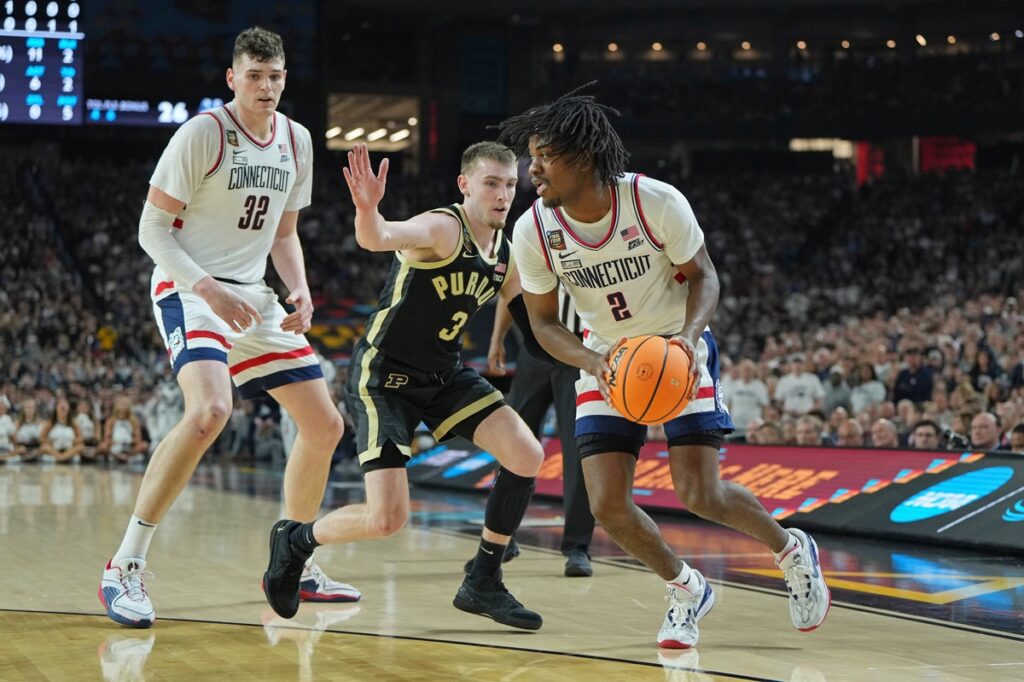
Twelve of the last 15 NCAA champions have ranked third or better in ESPN’s College Basketball Power Index, a ranking tool designed to predict a team’s future performance. The lone exceptions are UConn, which ranked 25th in its championship seasons of 2011 and 2014, and Kansas with ranked sixth in 2022.
Another prescient ranking system is the USA Today Coaches Poll. Over the past ten years, UConn is the only tournament champion to finish outside the top six in the poll during the final week of the regular season. They finished 19th in 2011 and 2014, and 12th in 2023. The lesson here is simple: unless you’re picking a school from Storrs, make sure your bracket’s champion is a top-six team in the Coaches Poll, and strongly consider picking one of the top three.
5. March Madness Champions Come from Schools with Large Student Bodies
In order to dominate March Madness, you need a large student body full of large student bodies. Every single NCAA Tournament champion from the past 15 years has come from a school with an enrollment of at least 10,000 students. Duke and Villanova are the two smallest schools — with enrollments of 10,000 and 14,000 respectively — while Kansas, Florida, UNC, UConn, Kentucky, Louisville, and Virginia are all home to at least 21,000 students. That doesn’t guarantee a school with 20,000 students will win (just ask the University of Central Florida), but it certainly weeds out smaller schools with less money and infrastructure.
6. March Madness Champions Can Light It Up from Deep
Every NCAA Tournament champion from the past 13 years has been an above-average three-point shooting squad. The 2010-11 Huskies and 2012-13 Cardinals finished on the low end of the spectrum at 33-percent.
The 2018 Villanova Wildcats took this trend to a new level, hitting just at just a shade over 40-percent (11th in the country) while attempting the fifth-most treys in the nation. The 2019 Virginia Cavaliers were almost as good, hitting 39.5% from three.
In 2021, Baylor put an exclamation point on this trend. The Bears were literally the best three-point shooting team in the country that year (41.3%) and were on fire in the title game against Gonzaga, going 10-23 (43.5%).
Before you etch your NCAA Tournament winner in stone, make sure they can shoot.
7. March Madness Champions Have Elite Defenses
It turns out that old chestnut about defense winning championships is actually true. Every single NCAA Tournament champion from the past 15 years has ranked in the top 25 in adjusted defensive efficiency at KenPom.com, the definitive source for college basketball analytics.
In fact, only 2022 Kansas and 2021 Baylor have ranked outside the top 15 in the stat and gone onto win the title.
Most Important Stats for March Madness
The table below distills most of the information above into a more-concise, digestible format.
| Trait | Threshold |
|---|---|
| Upperclassmen leaders | Two of top three scorers are seniors or juniors |
| Proven coaches | Multiple tournament appearances; >64.0 lifetime win %; > 10 years coaching experience |
| BPI | Rank top-five in ESPN BPI |
| Three-point accuracy | Hit at least 36% of threes; rank top-75 in 3P% |
| Elite defense | Rank top-25 in KenPom adjusted defensive efficiency |
General Tips for Picking March Madness Winners
As you consider all the trends above, think of these extra tips to help separate you from your bracket pool competitors:
- Don’t be Afraid to be Contrarian: The specifics of your bracket pool won’t be available to you until after the tournament starts, but you will be able to see public trends, and chances are your pool will be closely aligned. If 40% of the public is picking one winner, following along may not be the best idea. For one, you’ll need to separate yourself in the much more volatile early rounds, but you will also be gaining leverage on the rest of your pool by going against the grain.
- Pool Size Strategy: If you’re in a small pool of 10 people, you’re probably better off playing it safe, as picking the winner could be enough on its own. In larger pools that number in the 100s, however, you’re going to need to take some chances, including with your champion, to separate yourself.
- Check Pod Locations: Before the men’s tournament makes its way to Indianapolis for the Final Four, teams will travel to two different locations for the opening two weekends. Before locking in your winner, make sure to check where they’re playing. If Arizona gets sent into the Eastern Time Zone, that’s not ideal. Same with Michigan or Duke getting sent out West. Teams that have to travel cross country have struggled.
Picking March Madness Winners FAQs
The most reliable stat for picking March Madness winners over the past two decades is Ken Pomeroy’s defensive efficiency rating. All but two teams that have won since 2010 finished outside the top 15 in the stat, and most winners finish in the top five.
It depends on the team and the injury, but they can play a major role. If a top player goes down, not a lot of teams have the quality depth available to beat the other best teams in the country without that player.
KenPom and Bart Torvik are the best advanced statistical sites for projecting college basketball results.
Want More Sharp Tips?
If you’re in the market for some more advice on gaining a leg up on your sportsbook, you’ve come to the right place. Check out the rest of our strategy guides and boost your bankroll today! We cover everything from Final Four trends to regression systems like the Martingale system.
Make sure to click below to claim the best March Madness betting promos before the games tip off.
Managing Editor
Sascha has been working in the sports-betting industry since 2014, and quickly paired his strong writing skills with a burgeoning knowledge of probability and statistics. He holds an undergraduate degree in linguistics and a Juris Doctor from the University of British Columbia.