Trade $25 at Kalshi & Get a $25 Bonus!
Where is Kalshi Legal in the US? States Kalshi is Available

By Kevin Wolff
Updated:
If you’re wondering, is Kalshi legal in my state? You’ve come to the right place, as this page will cover everything you need to know about the legal status of Kalshi in your state, as well as a platform overview for new traders looking to get started.

KALSHI TRADING
Must be 18+ years or older & residing in the United States. Other Terms & Conditions may apply.
LOCK IN PROMO
CODE: DIME
CODE: DIME
Can You Use Kalshi in the United States?
Yes, you can use Kalshi in the United States, as the trading platform is legal and available for eligible users nationwide. Currently, Kalshi is legal in over 40 states throughout the country, including several locations where online betting sites are prohibited.
Making the platform even more enticing, there is a welcome offer for new customers to get started in the right direction when they begin trading on Kalshi. New users can register with the Kalshi referral code to unlock up to a $500 bonus when they make their first $25 in trades.
Be sure to check your eligibility before attempting to trade on Kalshi, as the platform is prohibited in select states. There is also an age requirement (18) to make an account and trade on Kalshi.
States Where Kalshi is Legal
Kalshi is legal in over 40 states throughout the country, and it has quickly become a top option for prediction market traders in the US and available prediction markets in California. The Kalshi platform is legal at a federal level (regulated by the CFTC), but has been challenged legally at a state level in several locations.
The current list of Kalshi legal states includes the following: Alabama, Alaska, Arkansas, California, Colorado, Connecticut, Delaware, Florida, Georgia, Hawaii, Idaho, Indiana, Iowa, Illinois, Kansas, Kentucky, Louisiana, Maine, Minnesota, Mississippi, Missouri, Nebraska, New Hampshire, New Mexico, New York, North Carolina, North Dakota, Oklahoma, Oregon, Pennsylvania, Rhode Island, South Carolina, Sout Dakota, Tennessee, Texas, Utah, Vemont, Virginia, Washington, West Virginia, Wisconsin, Wyoming, and DC.
It should be noted that some states restrict select markets, but not the Kalshi platform as a whole.
States Where Kalshi Might be Restricted
Although Kalshi is federally legal and regulated, several states have taken legal action to ban access to the trading platform or limit market access. There are currently nine states where Kalshi is unavailable and/or limited (select market access).
The list of states where Kalshi is currently unavailable includes: Arizona, Massachusetts, Maryland, Michigan, Montana, New Jersey, Nevada, and Ohio.
Be sure to check eligibility before claiming the Kalshi promo code and signing up for an account to trade event contracts.
What is Kalshi?
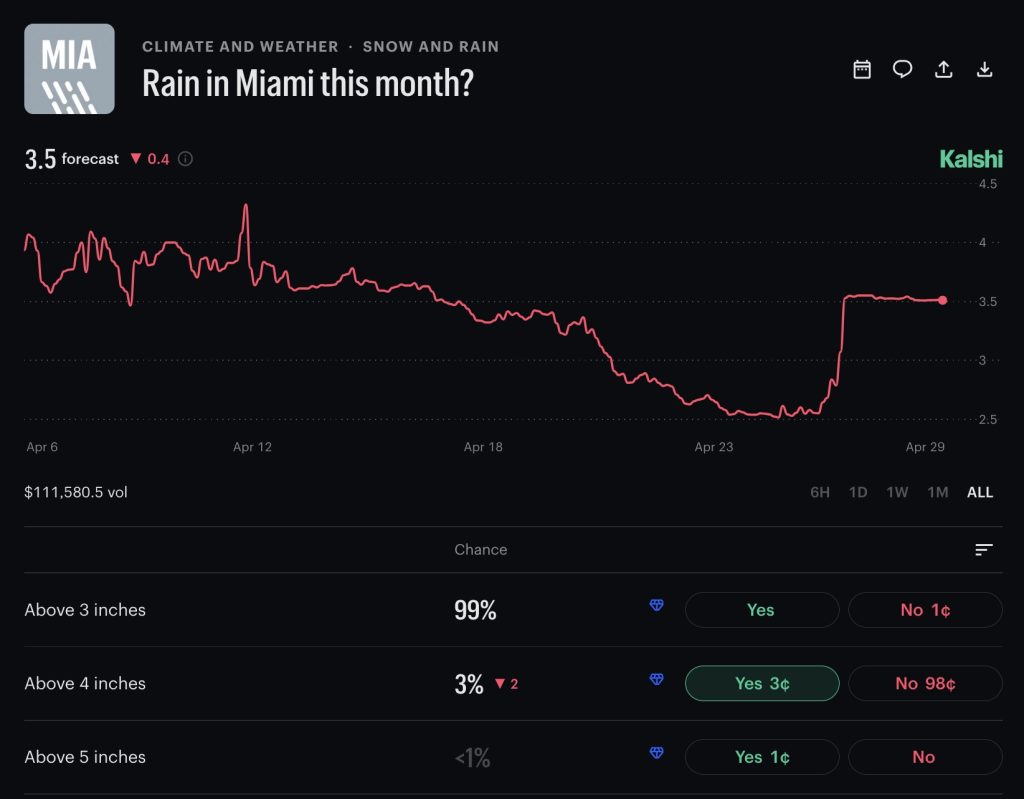
Kalshi is a federally regulated prediction markets exchange where users can trade event contracts for a wide range of real world outcomes. Trading categories include sports, politics, weather, entertainment, finance, and more, with users buying and selling contracts for simple Yes/No results of the events in question.
For example, a user might see a market for “Will it rain in Miami today?” Let’s say the chances are at 62% Yes (it will rain), and 38% No (it will not rain). In this scenario, the prices for the Yes side of the event would be $0.62 each, and the No side of the outcome would cost $0.32 per contract.
After trading on either side of the event, users will wait for the outcome to occur. When the outcome of the event is settled, the users who purchased the correct side (Yes/No) will win the full value of the contracts they hold ($1 each).
How is Kalshi Legal?
Kalshi is a legal trading platform, officially classified as a Designated Contract Market (DCM). Regulated by the Commodity Futures Trading Commission (CFTC), the Kalshi platform is a totally legitimate predictions exchange with all trades legal and official under federal regulation.
With trades on Kalshi, users are technically buying and selling event-based derivative contracts tied to real world outcomes. As a financial exchange platform, Kalshi is different than sportsbooks or online casinos, which are subject to different laws and regulations.
This explains why Kalshi is legal in states where sports betting is unavailable. Although it’s not the same as betting, trading sports on Kalshi allows users throughout the country to legally stake positions on sports games/events, as well as a bevy of other categories to trade on.
How Kalshi Works Compared to Sportsbooks
As a prediction markets exchange, Kalshi is categorically different from sportsbooks, and as such, it’s subject to a different set of rules and regulations. At its core, Kalshi is not betting or wagering, as is the case with online gambling sites. Instead, Kalshi traders are buying and selling event contracts for Yes/No outcomes of real world events.
With Kalshi, users are trading at a peer-to-peer level, buying and selling event contracts based on market prices and dictated by real world probabilities. In comparison, sportsbook users are betting/wagering on odds against the house (bookmakers).
There is no betting odds format for prediction markets like Kalshi. Instead, these platforms use trade-based systems for users to buy and sell contracts for fixed Yes/No outcomes of events across a wide range of categories.
While the results of trading contracts on a sports event are very similar to betting on that event using a sportsbook, prediction markets like Kalshi are different. With Kalshi regulated at a federal level, the platform is available for users to trade on sports markets in several states where online sportsbooks are prohibited.
How to Start Using Kalshi
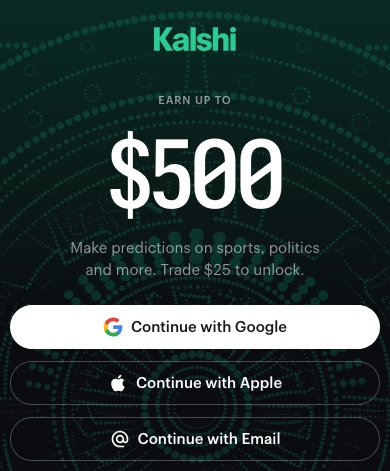
It’s very easy to get started on Kalshi to trade on prediction markets for a variety of real world events. Making the registration process even more welcoming, Kalshi offers a new user referral code that unlocks up to a $500 bonus after $25 in trades have been completed.
Step 1: Creating a Kalshi Account
To get started trading on Kalshi, users will first need to create an account. This is very easy to do, and the Kalshi referral code DIME will supply an offer to trade $25 and get up to a $500 bonus for new users to trade on markets. Download the Kalshi app using any of the links on this page and click the option to sign up for an account.
Users will be required to provide several credentials to register for an account. Get started using a Google/Apple account or providing an email address. Users will need to enter their full name, date of birth (must be at least 18 years of age), address, Social Security number, photo ID, and their phone number.
Step 2: Verify Your Identity
The Kalshi Know Your Customer (KYC) process will require users to verify their identity before they can register to trade on the platform. This can be completed by taking a selfie for photo ID to verify the credentials provided during the Kalshi sign up process.
Step 3: Deposit Funds
Once you have successfully created an account, the next step is to deposit funds using one of the available Kalshi payment methods. The minimum deposit amount on Kalshi varies by the method of payment. Most Kalshi deposit options are instant, though some carry associated processing times. Be sure to check the processing time and minimum/maximum limits before making a deposit on Kalshi.
The list of currently accepted Kalshi payment methods includes: Apple Pay, Bank Account, Credit/Debit Card, PayPal, Venmo, Cash App Pay, Crypto, and Wire Transfer.
Step 4: Trade Event Contracts
Now that you have registered on Kalshi in a legal state and deposited funds into your account, you’re ready to begin trading event contracts. Browse through the available markets on Kalshi to find an event to trade on. Users can sort the available markets on Kalshi by trending status, market trading volume, and time to market close. There is a menu list of categories for users to see markets for Sports, Politics, Entertainment, and other popular options.
When you have identified a market you wish to trade on, stake a side (Yes or No) of the event by purchasing event contracts for that outcome. Then, wait for the result to play out, and if your position(s) are correct, you will win the full value ($1) of each contract you own for that outcome.
For new traders who registered using the promo code DIME in states where Kalshi is legal, a $10 sign up bonus will be awarded once $10 in trades have been completed.
Tips Before Using Kalshi
Before trading on Kalshi, it’s important to understand contract pricing. Each side of the event in question will be priced based on the probability of that outcome. The full value of any contract on contracts Kalshi is $1, with each side of that event (Yes/No) priced based on the probability, and the action on the market of traders.
It’s key to monitor market movement, as developments can cause rapid changes in prices. This can create opportunities for users to trade (sell) their positions before the event has played out. Similar to a cash-out feature available on sportsbooks, this will guarantee profit before the event takes place.
FAQs About Where is Kalshi Legal in the US
Is Kalshi legal in Hawaii?
Yes, Kalshi is legal in Hawaii for eligible users to trade event contracts.
How is Kalshi legal?
Kalshi is legal, classified as a Designated Contract Market (DCM), and federally regulated by the Commodity Futures Trading Commission (CFTC).
Is Kalshi legal in Texas?
Yes, Kalshi is legal for eligible traders in Texas to buy and sell positions across a variety of markets.
Is Kalshi legal in New York?
Yes, Kalshi is legal and available in New York for eligible users to trade on real world outcomes.
Do you need to be in a betting state to use Kalshi?
No, users do not need to be in a betting state to use Kalshi. As a prediction markets platform, Kalshi is available in over 40 states, as it’s subject to a different set of rules and regulations compared to sportsbooks.
Can you us Kalshi on a mobile device?
Yes, Kalshi is available on mobile devices. The Kalshi app can be downloaded from the Apple App Store (iOS) or Google Play (Android).
After years of writing as well as Data Analyst work for Pro Football Focus, Kevin Wolff is now a Sports Betting Writer for SportRadar, and more specifically, SBD. A graduate of Fordham University in NYC, Kevin is also a full-time dog dad when he's not writing.
Sportsbooks
Gambling