Buying Points in Betting: When Is It Worth The Cost? (Math & Strategy)

Updated:
Buying points in sports betting is a method for bettors to make a line more favorable to them, increasing their win probability but diminishing their potential return.
It’s a longtime tactic for sports bettors, but buying points to move the point spread in a game has exploded with the availability of sports betting apps, which offer long lists of alternate lines at a bettor’s fingertips.
But when is buying points worth the cost?
The Basics of Buying Points in Sports Betting
It’s not always easy to find a bet you’re comfortable with, so online sportsbooks often provide other opportunities to entice bettors to risk their money. Buying points is one of the betting strategies available to get this done, as it reduces the risk of your wager. Though, it should go without saying that reduced risk equates to reduced potential winnings.
To buy a point you would simply select a betting market you want to wager on, and then find an alternate line in exchange of less potential profit for taking a lesser risk.
Bettors generally buy points in a spread bet, but it’s also possible to buy points to get a more favorable number on a totals (over/under) bet or with team and player props.
The number of points you can buy and how much it will cost you in odds movement will depend on the sportsbook you use, so it may be very different at DraftKings than it is at BetMGM. But a half-point or full-point are the most common options when coming up with a bet that still offers a decent return. The influx of same game parlays, however, have made buying massive amounts of points through alt lines on a spread or total, palatable, as they’re combined with other bets for favorable odds.
The Hidden Cost: Why Buying Points is Usually Negative Expected Value
When buying points, you must understand the math that comes along with it, and the tax you’re paying to get the more favorable line.
A standard bet will come in with -110 odds on a spread, and if you make several of them, you would need to win more than 52.38% of your bets to profit. Buying half a point is going to knock them to at least -120, and you would need a win rate of better than 54.55% over the course of multiple -120 bets to make a profit.
So, is that extra half point turning your loss into a win or push enough to justify the extra 2.2% win rate needed? Spoiler: Rarely, with three being the exception.
The chart below shows key numbers in football spreads, and how often NFL games land directly on them.
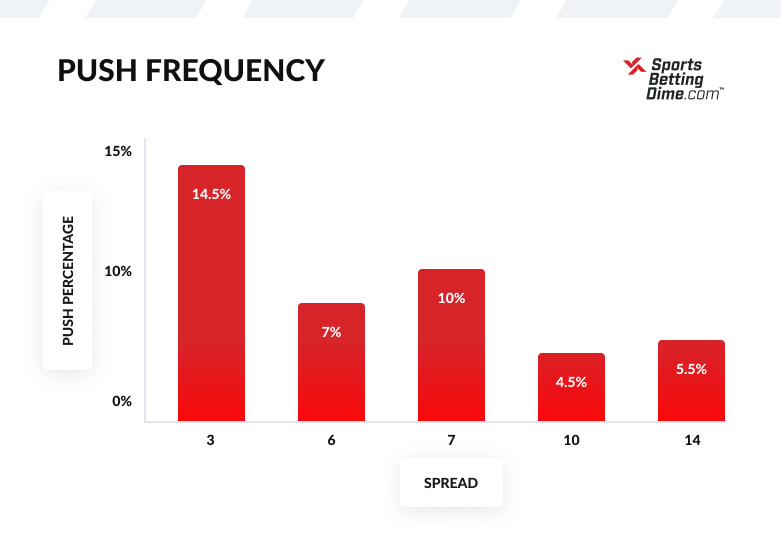
Buying points from any number other than three or seven when NFL betting really isn’t worth it. They are the most common final score differentials in the league, which should come as no surprise as they’re the two main units of scoring.
Since nearly a quarter of NFL games land on those key numbers, getting to the good side of a field goal or touchdown spread does make sense, even if it’s going to cost you a little more.
The only other number to really consider buying off or onto is six, with 14 and 10 close behind. But with less than 10 percent of games ending on any of those, the probability of hitting those numbers isn’t worth the drop in price.
What is the Maximum Price to Buy Points in Sports Betting?
So, when is the price fair?
Again, you probably only want to buy points around a three or seven, as they are the only scores common enough to justify the odds movement. But even with those numbers, there are limits to how far you want to go.
- Buying from -3 to -2.5 on a favorite or +3 to +3.5 on an underdog
- Fair Price: -125 or better
- Bad Price: -135 or worse
- Buying from -7 to -6.5 or +7 to +7.5
- Fair Price: -120 or better
- Bad Price: Worse than -120
- Buying from -5 to -4.5
- Just don’t do it.
For some other key numbers, like six, 10 and 14, buying the half point is also not recommended.
What Does it Mean To Sell Points?
Selling points holds the same concept as buying points except you are adding to your risk and increasing your potential winnings rather than playing it safer.
Using the Green Bay Packers vs New York Giants example above, if you believed the Packers would win the game by anything more than just one field goal it would be wise to sell points. Since in football field goals are worth three points and touchdowns are worth six (plus extra points), you can take advantage of those point margins and sell points to increase the -3 spread to -4 since you believe the game will be at least a six-point (one touchdown) difference. You would earn more winnings for creating a bigger spread for yourself.
Alternative Lines Explained
Alternative lines (or alternative spreads) are most prominent in football. Where buying and selling points is a two-step process (choose line then buy or sell the point), alternative lines are a one-step task. It is as simple as: if you don’t like the original spread on a game, you can just select an alternative spread instead.
For example, if you thought a certain team was going to win a game by over two touchdowns (14 points) and the spread was only -4.5 for that favorite, you could look to the alternative spread category of betting and select a -14.5 spread for yourself.
You are making a bolder statement and taking more of a risk, so in return, your potential winnings increase as a reflection of that.
Finding alt lines in player props has become standard practice in building a SGP. While Derrick Henry rushing for 50+ yards in a game won’t pay much, combining it with Lamar Jackson throwing for 200+, Henry ATTD and a more favorable Ravens spread could get you to a decent payout.
Is Buying Points the Same in All Sports?
Football is by far the most flexible when it comes to moving lines, but it is certainly not the same across the sporting world.
You can buy points when you’re betting on the NBA or college basketball, but because it scores by one, two, and three points buying just a half-point can be more valuable than in football as it has more of an impact on the final score.
There isn’t much of an opportunity to move the “puck line” in hockey because the betting line is always set at -1.5 due to low scoring totals.
Like the NHL, betting on the MLB doesn’t allow run lines to be moved, but you can buy points on the total runs scored.
Evergreen Writer/Editor; Sportsbook Expert
With nearly two decades of experience in sports media, Paul Costanzo turned his professional attention to sports betting and online gambling in January of 2022. He's covered every angle of the industry since then, managing and creating content for PlayMichigan and The Sporting News, and now SBD.