The 11 March Madness Betting First-Round Trends You Need to Know

By Sascha Paruk
Updated:
Verified by: Patrick Cwiklinski
- First Four participants are dangerous once they enter the field
- No. 10 seeds don’t win a ton early, but have staying power when they do
- The Big Ten is title-less, but coming off a perfect Round of 64 in 2025
Any experienced NCAAB bettor knows March Madness’ reputation for upsets, buzzer-beaters, and more havoc than a Shaka Smart defense on amphetamines. But is there really as much chaos to the tournament as there appears, or are have we all fallen victim to YouTube bias?
 BETMGM SPORTSBOOK
USE CODE SBD1500 TO GET UP TO $1,500 PAID BACK IN BONUS BETS
 THESCORE BET SPORTSBOOK
USE CODE DIME TO GET 100% BET RESET UP TO $1,000
 DRAFTKINGS SPORTSBOOK
SPEND $5, GET $200 IN BONUSES!
 BET365 SPORTSBOOK
BET $10 & GET $365 IN BONUS BETS
 CAESARS SPORTSBOOK
USE CODE SBDDYW & DOUBLE YOUR WINNINGS ON YOUR FIRST 10 WAGERS!
 FANATICS SPORTSBOOK
USE CODE DIMEFAN & GET $10 x $100 BET MATCHES IN FANCASH!
 FANDUEL SPORTSBOOK
BET $5 FOR 7 DAYS & GET UP TO $350 IN BONUS BETS!
DRAFTKINGS T&Cs: GAMBLING PROBLEM? CALL 1-800-GAMBLER or 1-800-MY-RESET, (800) 327-5050 or visit gamblinghelplinema.org (MA) Please Gamble Responsibly. 888-789-7777/visit ccpg.org (CT), or visit www.mdgamblinghelp.org (MD), 1-800-981-0023 (PR). 21+ and present in most states. (18+ DC/NH/PR/WY). Void in CAN. Eligibility restrictions apply. On behalf of Boot Hill Casino (KS). Pass-thru of per wager tax may apply in IL. 1 per new DraftKings customer. $5+ first-time bet req. Max. $200 issued as non-withdrawable Bonus Bets. Stake removed from payout. Reward issued as $50 in Bonus Bets every 7 days via click-to-claim for 21 days. Bonus Bets and click-to-claims expire 7 days (168hrs) after issuance. Terms: sportsbook.draftkings.com/promos. Ends 9/20/26 at 11:59 PM ET. Sponsored by DK.
BET365 SPORTSBOOK T&Cs: GAMBLING PROBLEM? CALL 1-800-GAMBLER or 1-800-MY-RESET (AZ, CO, IL, IN, KS, KY, LA, MD, MI, MO, NC, NJ, OH, PA, TN, VA) or 1-800-BETS OFF (IA). 21+ only (18+ in KY). Please gamble responsibly. Must be present in AZ/CO/IA/IL/IN/KS/KY/LA (select parishes)/MD/MI/MO/NC/NJ/OH/PA/TN/VA. Minimum $10 deposit required. Minimum odds -500 of greater. Bonus Bets wager excluded from returns. New customers only. T&CS, time limits and exclusions apply.
BETMGM T&Cs: Gambling problem? Call 1-800-GAMBLER or 1-800-MY-RESET (Available in the US), 877-8-HOPENY or text HOPENY (467369) (NY), 1-800-327-5050 (MA), 1-800-BETS-OFF (IA), 1-800-981-0023 (PR). 21+ only. Please Gamble Responsibly. See BetMGM.com for Terms. First Bet Offer for new customers only (if applicable). Subject to eligibility requirements. Bonus bets are non-withdrawable. In partnership with Kansas Crossing Casino and Hotel. Promotional offers not available in MS, NY, NV, ON, or PR.
March Madness Betting Trends
Even though you’ve watched the highlights of #15 Lehigh beating #2 Duke 35 times, it still only happened once.
To get a more accurate sense of how the first weekend of March Madness tends to play out, eschew the videos and look to the trends. Below are 11 of the best, strangest, and most-bankable trends for the first two rounds of the NCAA Tournament.
1. Only two #1 seeds have ever lost in the first round
We will get to stats you haven’t already heard a thousand times in short order, but every March Madness trends article has to start here. In 2018, when #16 UMBC beat #1 Virginia, it was the first time a #1 seed had ever lost in the first round.
But it happened again in 2023 when #16 Fairleigh Dickinson shocked Zach Edey and #1 Purdue (63-58).
Prior to that, only two #16 seeds had ever lost by less than a bucket. Top seeds are now 154-2 against #16 seeds.
2. First Four momentum is real
The 2025 NCAA Tournament was an outlier for First Four teams, as none won their Round of 64 game.
But in 12 of the prior 13 seasons, at least one team that participated in the First Four won their next game to advance to the Round of 32. That includes two teams (VCU in 2011 and UCLA in 2021) that advanced all the way to the Final Four.
Now, this is typically just reserved for the at-large First Four teams, who are coming in as an 11 or 12 seed. These are often teams that underperformed to their talent in the regular season, but snuck in, which makes them dangerous. The First Four auto qualifiers are 16 seeds, and only Fairleigh Dickinson has pulled off that feat.
3. Early afternoon games can feature poor shooting
You might want to take a look at the Under, particularly First Half Unders in the NCAA Tournament games played early in the day on Thursday and Friday of the opening weekend.
Players aren’t used to playing at that time of day, and shooting percentages do drop (1.6% on 2-pointers and 1.7% on 3-pointers). That might not seem like a lot, but when it comes to picking Vegas totals, which can be remarkably accurate, those small percentages can make a big difference.
4. The #7 seeds crush the #10 seeds
That’s overstating it a bit, but given the NCAA Tournament’s reputation for upsets, a lot of amateur bracketologists assume that the #7-vs-#10 matchups are basically toss-ups, and that’s not the least bit true. The #7 seeds have won at a 60.3% clip and are 94-62 all-time.
5. But the #10 seeds have staying power
When #10 seeds survive the Round of 64, they’re batting nearly 42% in the Round of 32.
The history of #10 seeds in the first round isn’t great (see above). Yet, when they do survive the Round of 64, they’re batting 41.6% in the Round of 32, going 26-36 all-time. A year ago, Arkansas advanced to the Sweet 16 as a 10 seed, while New Mexico fell in the second round.
If there’s a #10 seed you love in the first round, take a hard look at their matchup in the second round and don’t assume they’ll be one-and-done.
6. Is the Big Ten back?
The Big Ten has not produced an NCAA Tournament winner since Michigan State won it all in 2000. But when it comes to the first round, life is good in the Midwest.
In 2025, the Big Ten was 8-0 in the first round, both straight up and against the spread. Here’s a look at how each conference did in the first round a year ago:
7. The #9 seeds are one-hit wonders
The #8 vs #9 games are true coin-flips (78-74 in favor of the #9 seeds since 1985, including a split in 2025), and the selection committee has long said that the eight teams grouped in the #8-9 range are treated as equals. That makes the discrepancy in their second-round success really strange: #8 seeds are 16-60 (21% win-rate), while #9 seeds are an atrocious 8-72 (10% win-rate).
8. Underdogs have covered 34 of the last 58 games between #8 & #9 seeds.
Again, #8 and #9 seeds are almost in a dead-heat over the last 33 years, and the parity has translated to the betting realm. Taking the points has been the wise move 57.1% of the time over the last 15 tournaments.
9. The #11 seeds are first-round phenoms
Going back to the 2011 tournament, #11 seeds are nearly .500 against #6 seeds in the first round, going 27-29 in that span. That’s despite going just 1-3 in 2025, with only Drake winning as an 11.
But 11 seeds have a strong recent history. In the 2017 tournament, Xavier, USC, and Rhode Island all won as #11 seeds, and Xavier advanced all the way to the Elite Eight.
In 2019, both #11 Syracuse and #11 Loyola-Chicago won multiple games. Syracuse and UCLA did the same in 2021.
In the 2022 edition, Notre Dame, Michigan, and Iowa State all won their first-round matchups as #11s, with Michigan and Iowa State advancing to the Sweet 16.
10. The #13 line is the parity cut-off
Every year, talking-heads (and, to some extent, computer algorithms) detail the increased parity in the college game. It’s also well documented that #12 seeds (55-101 all-time; 35.3% win-rate) are almost as good as #11 seeds (59-97 all-time; 37.8% win-rate) in the Round of 64 historically.
When you get to #13 seeds, though, David runs out of rocks and Goliath pulverizes the word parity between his heartless hands. The #13 seeds are a dismal 32-124 (20.5% win-rate) in the Round of 64.
11. Some teams just can’t get off the schneid
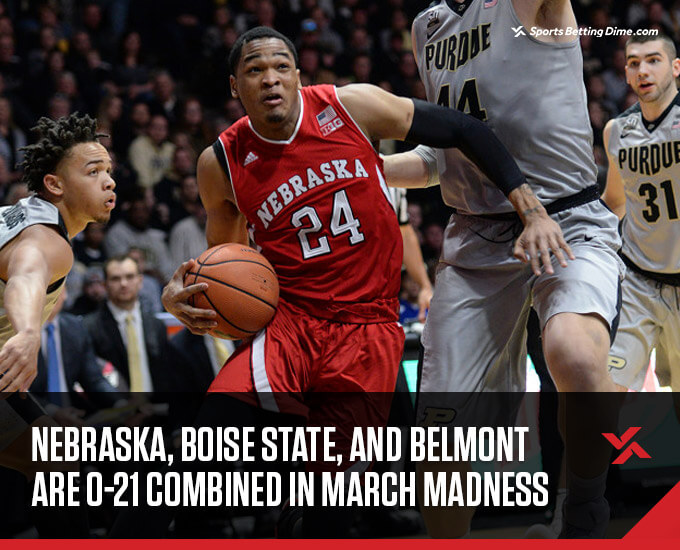
Neither Boise State (0-9), Nebraska (0-7), Belmont (0-8), nor Eastern Kentucky (0-8) has ever won a tournament game.
Contrast that with perennial mid-major power Gonzaga, which is 15-0 in the Round of 64 since 2009.
March Madness First Round FAQs
After winning two games in 2025, No. 12 seeds are no2 55-101 all-time against No. 5 seeds in the first round. That’s a 35.3% win rate.
Automatic qualifiers that play in the First Four do not tend to win in the first round, as they are 16 seeds. Only Fairleigh Dickinson has pulled that off. But at least one First Four participant has won a first round game in 12 of the 14 years the First Four has existed.
Double digit favorites win outright more than 90% of the time, but they struggle to cover, doing so at a 49.9% rate.
The average number of upsets in the first round of the NCAA Tournament is almost five, with between 4 and 8 double digit seeds winning each year. In 2025, there were seven seeded upsets and five double-digit seeds who won their first-round game.
Free throw percentage has not been an overly important stats for underdogs who pull an upset, but it has been an important factor for the teams that lose. So, when targeting a first-round upset, look for favorites who shoot poorly from the FT line as opposed to underdogs who shoot well.
Looking for More March Madness Trend Analysis?
If you want to take your March Madness bets to the next level, you’ve come to the right place. Once the first round is in the rear-view mirror, check out our guide to perennial betting trends in the Sweet 16 and the Elite 8, as well as the 7 key attributes of March Madness winners.
If you’re in the market for sports betting strategy that you can apply to whichever sports you elect to bet on, we’ve got you covered as well. Get out there and grow your bankroll!
Managing Editor
Sascha has been working in the sports-betting industry since 2014, and quickly paired his strong writing skills with a burgeoning knowledge of probability and statistics. He holds an undergraduate degree in linguistics and a Juris Doctor from the University of British Columbia.