Surviving the Schedule: How Back-to-Back Games Will Hurt or Help NBA Teams in 2026-27

By Paul Costanzo in NBA Basketball
Published:
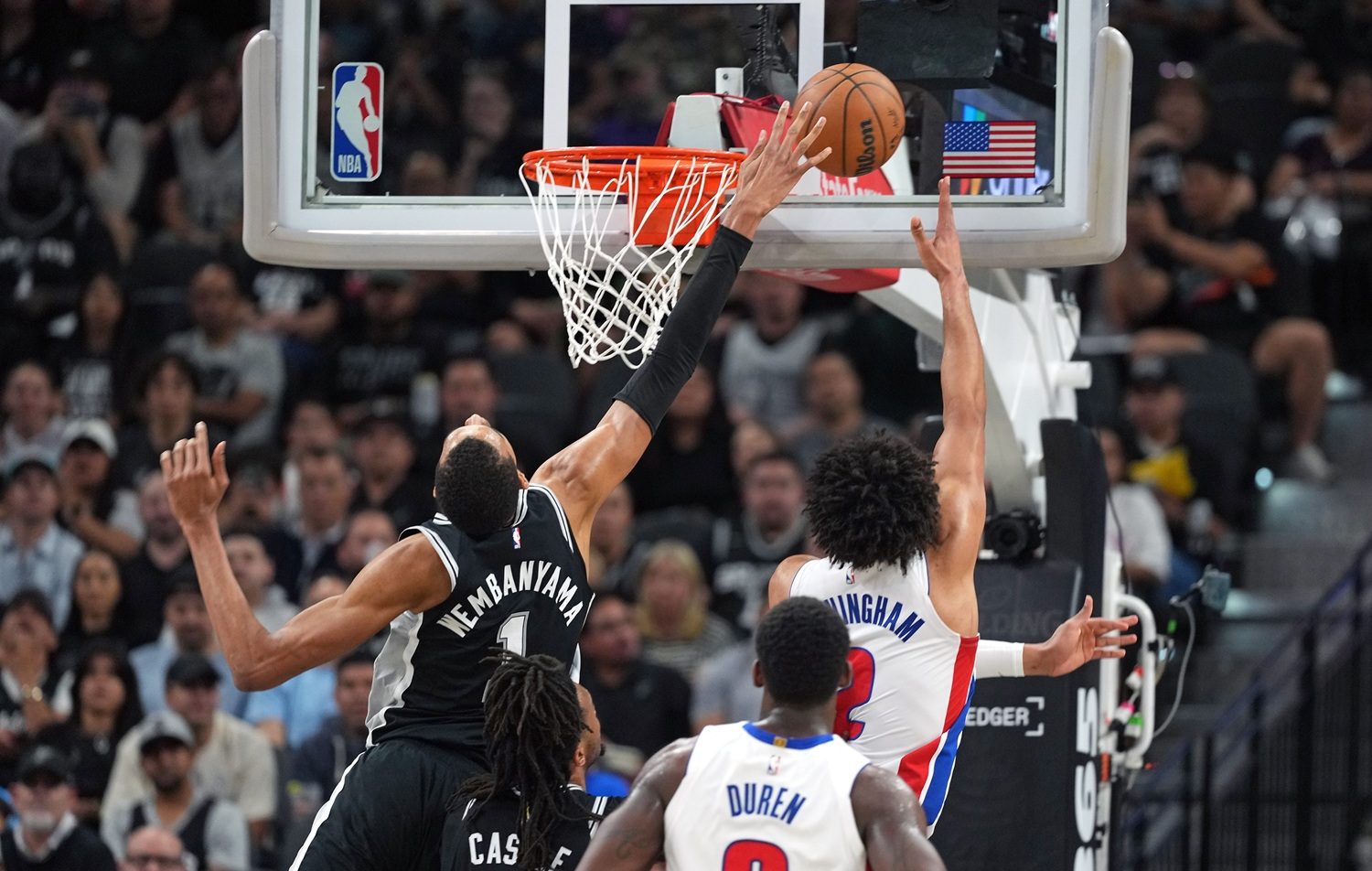
The second game of a back-to-back has been targeted by NBA bettors for years.
Lack of rest and load management for star players should provide an opportunity to gain an edge, right?
While NBA teams perform slightly worse collectively on the second night of a back-to-back, it’s not that straight forward. Some teams are built for it, while others are not. Luckily for you, we’ve identified teams on both ends of the spectrum, including a surprising stat on the Oklahoma City Thunder, who are title co-favorites at Kalshi, coming in at 22%.
How Do NBA Teams Perform With Zero Rest?
The top-line number for back-to-backs in the NBA isn’t a surprise. Teams only win about 44% of their games on the second night of a back-to-back, compared to 51% with standard rest.
Their NET rating, which measures point differential per 100 possessions, dropped by a collective average of 1.5 points in the 2025-26 season. The median drop off was 1.2 as 12 teams actually performed slightly better without rest, while the other 18 were worse.
So yes, there is a drop off.
Which NBA Teams Were Worst in Back-to-Backs?
The NBA’s bottom feeders throughout the 2025-26 season were also the league’s worst teams on the second night of a back-to-back.
Brooklyn was 1-13, Washington was 1-15, Memphis was 3-11, Indiana was 3-10… you get it.
Lottery teams were actually at their worst late in the season when it came to zero-rest games, going 91-211 in the final third of the season, a .301 win percentage, which was more than 8 percentage points below their regular-rest rate.
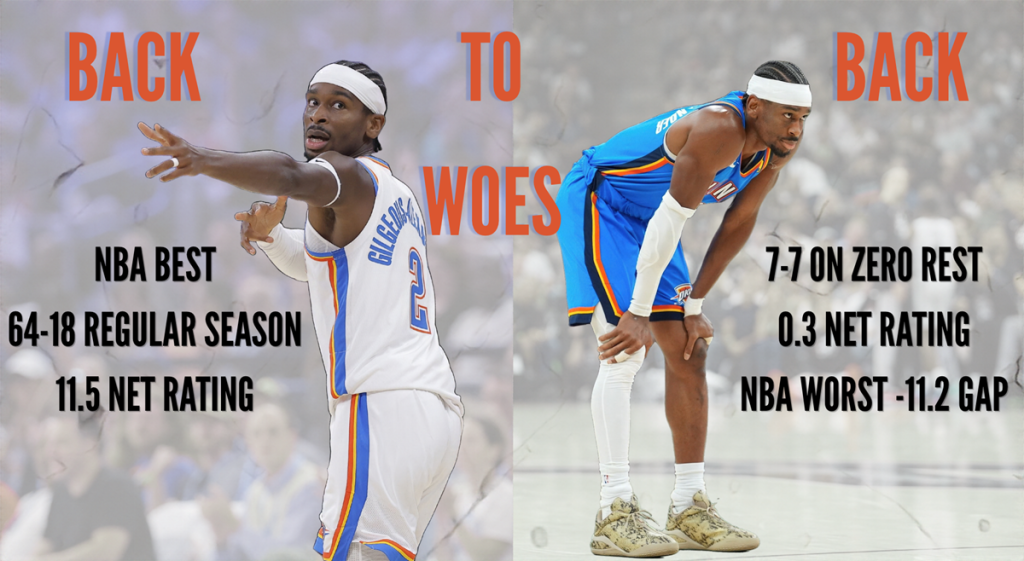
But here’s the big surprise: the team that underperformed the most on the second night of a back-to-back compared to the rest of its season was the Oklahoma City Thunder. They were just 7-7 in zero-rest games, with a 0.3 NET rating. That’s compared to the 11.5 NET rating they carried over the course of the season.
Houston was also among the biggest underachievers on Night 2 of a back-to-back, going 7-7, as well, and underperforming their season-long NET rating by -6.6.
NBA Teams That Were Best on Zero Rest
Some teams not only seemed unaffected by a back-to-back, but thrived. The San Antonio Spurs (12-2), Detroit Pistons (12-3), Philadelphia 76ers (12-4), and Miami Heat (13-4) were all perfectly fine playing on zero rest in the 2025-26 season.
Not only were they fine, they were better. The 76ers had a season-long NET of 0.4, but were at 6.2 on zero rest. Even the Spurs, who were second in NET rating during the season, and the Pistons who were third, overperformed by 2.8 and 2 points, respectively.
Even Utah, which had a season-long NET rating of -8, was better on zero rest with a NET rating of -2.9. Still negative, of course, but somehow much better.
Are Youth and Depth the Biggest Factors for Back-to-Back Success?
Depth and youth feel like they should key factors in surviving or thriving zero-rest games. And those things definitely don’t hurt.
The Pistons and Spurs both had a good mix of that, individual performances back it up. Victor Wembanyama and Devin Vassell had the Nos. 2 and 4 bets NET ratings in the league on the second night of back-to-backs, and did so at 22 and 25.
Pistons’ reserve Paul Reed was the league’s top player in NET rating on the second night of a back-to-back. B-Ball Paul was a key figure off the bench for Detroit as it put together the East’s best record in 2025-26.
But the Thunder are also incredibly deep and, based on minutes-weighted age, are younger than both the Spurs and Pistons.
The Nets and Wizards were the two youngest teams in the league and both underperformed their already brutal regular-season NET rating when on the second night of a back-to-back. The Hornets and Jazz, meanwhile, were 3 and 4 and overperformed. So, it’s tough to draw any correlation.
Depth also didn’t seem to stand out as the Thunder, Rockets, and Toronto Raptors, playoff teams who were underperformers on back-to-backs, are among the deepest teams in the league.
Youth and depth can help, if it’s the right kind. But it isn’t the deciding factor.
Half-Court Supremacy Led to Most Back-to-Back Success
Strong halfcourt defense, anchored by a rim protector, and efficient halfcourt offense were the biggest common factors for teams who had success on the second night of a back-to-back.
The Spurs had a league-best 105.5 defensive rating on back-to-backs, with their opponents being held to a 51.8% effective field goal percentage. Wembanyama, of course, led the league in blocks.
Detroit had more blocks than any other team in the league during the season, averaging 6.4 per game, and its 108.7 defensive rating and 53% eFG with zero rest showed that defensive prowess carried over.
Offensive efficiency in the halfcourt was equally important, as proven by Nikola Jokic and the Denver Nuggets, who had the best offense throughout the season and continued to while on zero rest with a 120.5 offensive rating, going 11-6. That’s despite Aaron Gordon sitting out seven of those games.
Time of Year Matters for Back-to-Backs
Over the past five years, teams have actually gotten better in back-to-backs as the season has gone on, as their offenses become more efficient, and players settle into roles defensively.
In the final third of the season, teams were 349-416 (.456 win percentage) on zero rest, while they were 294-379 (.437) in the first third and 312-387 (.446) in the middle.
December is the worst month, traditionally, as teams have gone 133-189 (.413). Not only is it the holiday season, but the NBA Cup messes with scheduling during that time as well.
February, meanwhile, is the best month, as teams were 151-165 (.478). That month features the All-Star break, the longest extended rest for teams during the season.
Teams With Biggest Back-to-Back Red Flags in 2026-27
Picking on the Brooklyn Nets seems like piling on, but the schedule makers did them no favors this season.
Not only do they have 16 back-to-backs, tied for most in the league, but they also have four between Thanksgiving and New Years. For a team that figures to struggle already and find itself in the lottery, things could get even uglier late, as they have four more over the final month of the season.
Dallas also has 16, with 10 coming before February. The Mavericks were tied for last in eFG% on the second night of back-to-backs last season, and in the bottom half defensively. That could get even harder this year.
Teams Built to Survive Back-to-Backs in 2026-27
Miami had a massive offseason, adding Giannis Antetokounmpo and Klay Thompson to a frontcourt that already featured Bam Adebayo. The Heat were great on zero rest a year ago and could be even better this year.
They also have just 13 back-to-backs, with a single one in December, so the schedule gods shined upon them when they didn’t really need it.
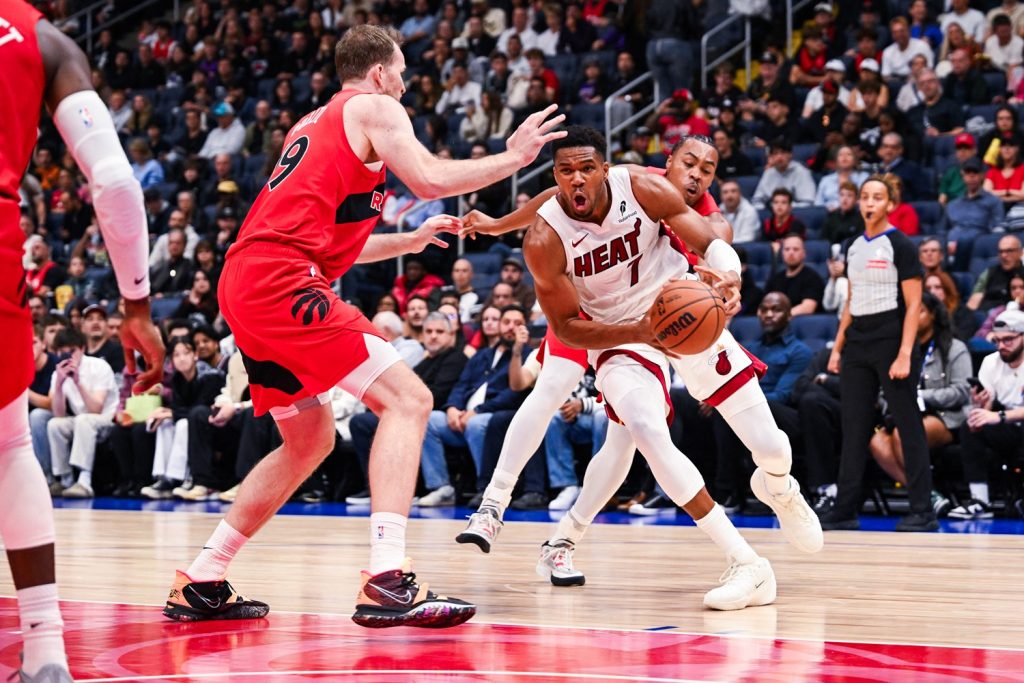
Speaking of not needing it, the defending champion Knicks also have just 13 back-to-backs this season, including two in December. Those are spread out, though, coming on Dec. 1 and 2, and then again on Dec. 30 and 31. More than half of their back-to-backs will hit after Feb. 1.
Bets to Target Based on Back-to-Back Schedules
If you’re taking this information to your favorite NBA betting apps, here are some suggestions:
- New York Knicks Atlantic Division Winner (33% at Kalshi): The Knicks friendly back-to-back schedule is the opposite of its main Atlantic Division rivals. The Celtics have 16, tied for most in the league. The 76ers have just 13, tied for lowest, but eight of them will be played before February. In a race expected to be incredibly tight, scheduling could make the ultimate difference.
- Brooklyn Nets Under 24.5 Wins (-120 at BetMGM): It’s going to be tough for the Nets to improve upon last year’s 20 wins with the schedule they’ve been given.
- Miami Heat Over 46.5 Wins (+100 at theScore Bet): Adding Giannis is massive, of course, and could have been enough to get them over this number on its own. But when you add in the friendly schedule, and how his presence should help the Heat be more efficient in the half court on both sides of the ball, that’s quite the recipe for success.
Evergreen Writer/Editor; Sportsbook Expert
With nearly two decades of experience in sports media, Paul Costanzo turned his professional attention to sports betting and online gambling in January of 2022. He's covered every angle of the industry since then, managing and creating content for PlayMichigan and The Sporting News, and now SBD.