Minnesota Vikings vs Chicago Bears Player Props: Best Prop Bets & Predictions
By Michael Schwartz in NFL News
Published:
I see plenty of star power to target for player props when the Minnesota Vikings visit the Chicago Bears this afternoon at 1:00 PM EDT at Soldier Field on FOX. For Chicago, quarterback Caleb Williams looks to build on a strong start alongside offensive weapons like Rome Odunze and D’Andre Swift. Minnesota counters with one of the league’s best playmakers in Justin Jefferson catching passes, however Carson Wentz will lead the offense with Kyler Murray sidelined with a concussion. This sets up an intriguing game for the betting markets. Here are my top player prop picks to target in this matchup.
Best Player Prop Picks for Vikings vs Bears
The betting value in this matchup leans heavily on historical performance and exploitable defensive metrics. With both secondaries struggling to contain the passing game early in the season, I can find strong opportunities backing reliable targets and fading specific rushing volumes in the prop market.
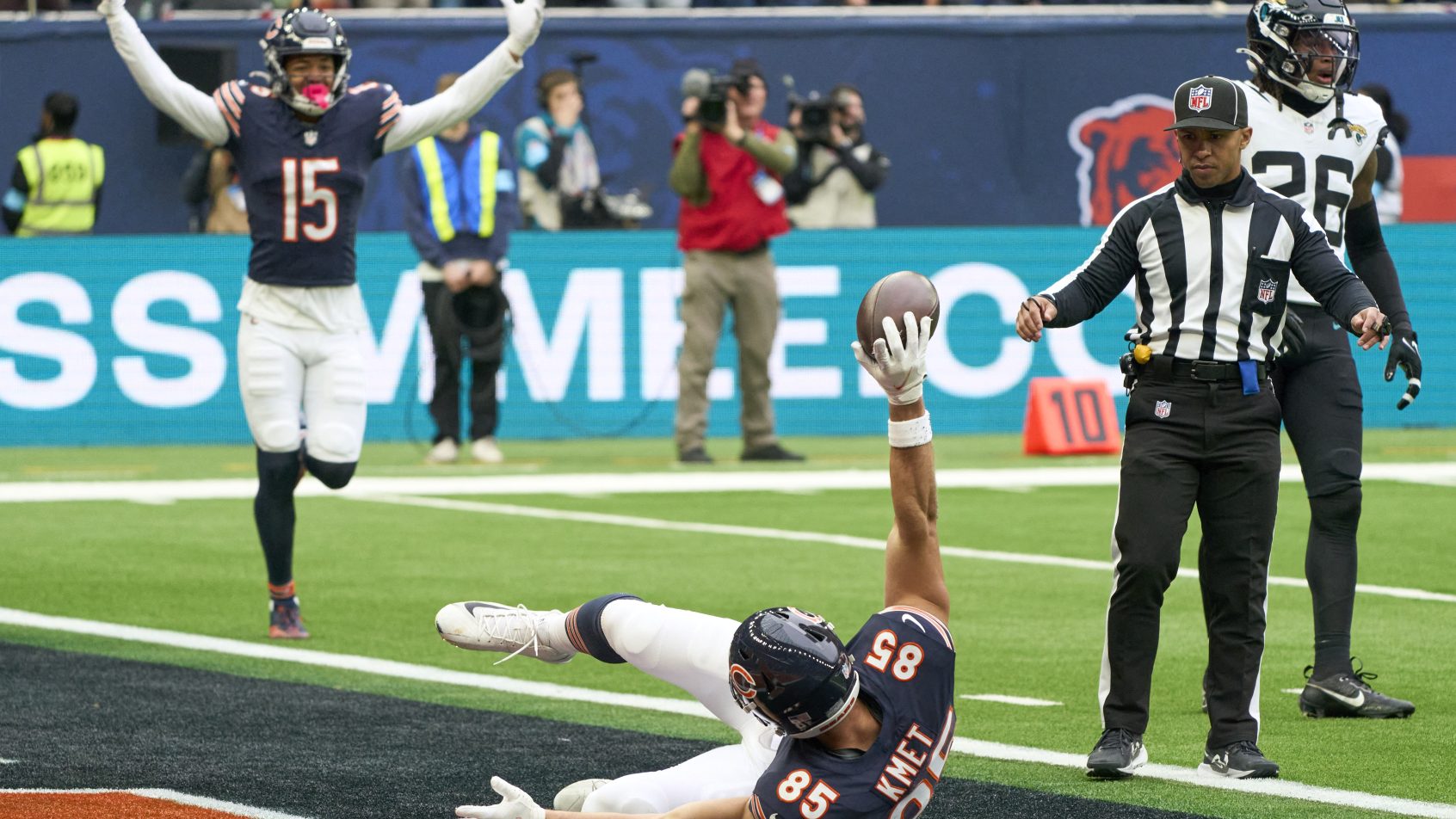
Cole Kmet 15+ Receiving Yards (+104, Kalshi)
The Chicago tight end has consistently capitalized on this specific divisional matchup. Kmet has exceeded 14.5 receiving yards in six of his last eight career games against the Vikings, averaging a stout 38.5 receiving yards per contest. That reliable track record aligns seamlessly with how Chicago’s passing game attacks Minnesota’s structural defensive tendencies. Brian Flores’ aggressive blitz packages consistently leave the intermediate middle vacated, creating ideal soft spots for tight end releases.
Kmet’s sustained role as a primary safety valve is tailored for this exact matchup. Over his last two seasons, he has logged a 74% route participation rate on passing downs while securing an 81.4% catch rate against divisional opponents. Because he averages 10.4 yards per reception across his career against Minnesota, Kmet routinely eclipses a modest 13.5-yard total on just one or two quick intermediate completions.
Minnesota’s coverage scheme has consistently ranked among the league leaders in blitz rate over the past two seasons, forcing rapid-release throws into the short and intermediate flats where Kmet runs nearly 70% of his routes. With Chicago actively designing underneath crossers and red-zone seam routes to counter pressure fronts, Kmet’s established floor and steady snap volume make clearing 14.5 receiving yards an exceptionally high-probability outcome.
Rome Odunze 40+ Receiving Yards (-108, Kalshi)
The Bears passing attack has a highly favorable setup against a Minnesota secondary that frequently surrenders chunk plays downfield. That environment perfectly suits Odunze, who has established a reliable production floor at Soldier Field. He has exceeded 39.5 receiving yards in four consecutive home games, averaging 56.8 receiving yards per contest. Facing aggressive defensive schemes designed to leave boundary receivers in single coverage, Odunze is well-positioned to extend his home production.
Odunze’s downfield usage metrics point directly toward a high-yardage ceiling. He consistently commands a team-high air-yards share paired with an average depth of target (aDOT) exceeding 12.5 yards, all while running routes on over 85% of Chicago’s dropbacks. With that distinct perimeter profile, Odunze does not rely on heavy target volume to clear this prop as his explosive play rate allows him to generate 40+ yards on just two or three chunk receptions.
Minnesota’s defensive scheme relies heavily on Cover-0 and Cover-1 looks with no deep safety help, a structure that has yielded high explosive pass play rates (20+ yards) to opposing perimeter receivers over the past two seasons. When combined with Odunze’s proven ability to separate on vertical and intermediate out-breaking routes, one or two splash plays will easily push him over the 39.5-yard threshold.
Aaron Jones Under 16.5 Rush Attempts (-117, Kalshi)
While Aaron Jones leads the Minnesota ground game, his rushing volume typically decreases away from home. He has failed to exceed 16.5 rushing attempts in 8 of his last 9 games on the road, averaging just 10.3 rushing attempts per contest. Minnesota’s offensive game planning and heavy neutral pass frequency make it difficult for any individual rusher to command a workhorse rushing workload in road environments.
Minnesota’s backfield snap distribution and scheme heavily cap Jones’ pure carry ceiling. The coaching staff deliberately manages Jones’ touch counts by rotating secondary rushers on early downs and deploying Jones heavily in the two-minute drill and third-down passing situations which are snaps that yield targets rather than rushing attempts. Over his last two seasons across all road starts, Jones has registered 17 or more carries only twice.
Kevin O’Connell’s offense has consistently finished among the league’s top ten in neutral-script pass rate over the last three seasons. When playing on the road in divisional matchups, Minnesota routinely relies on the quick passing game as an extension of the ground attack to control tempo. With Chicago’s defensive front historically prioritizing early-down run fits, game flow should naturally favor passing dropbacks, keeping Jones well under 16.5 rushing attempts.