The Complete Guide to Responsible Gambling Tools on US Sportsbooks

Updated:

Responsible gambling is a critical piece of legal gambling, both online and in person.
Betting on sports and playing casino games is meant to be fun and safe, and that is only possible if it is done responsibly.
National and state responsible gaming resources are available for bettors, and betting apps have made it a priority to help keep their customers safe.
What is Responsible Gambling?
Responsible gambling means safely participating in legal gambling, either online using a sports betting or online casino app, or in person at a sportsbook or casino.
Characteristics of responsible gambling include taking breaks, setting monetary and time limits, only gambling amounts you can afford to lose, and not using gambling as a source of income.
Standard Responsible Gaming Tools
With the legalization of online gambling spreading across the country, various responsible gaming tools have been implemented to keep bettors safe.
The following tools are available at the top online betting apps.
Deposit Limits
You can set the amount of money you can deposit into your account during a set timeframe, whether it be daily, weekly, or monthly.
Wager / Spend Limits
Restrict the amount of money you can wager on a single bet or that you can lose while playing casino games.
Time Limits / Reality Checks
By setting time limits or reality checks, you’ll receive a pop-up when you’ve been active on the app for a set amount of time. Some sports betting sites will send you these even if you haven’t set anything.
Cool-Off / Timeout Periods
You can take a break from betting on an app with a cooling off period or timeout. This is a temporary break, typically lasting 72 hours to 30 days, when the account is suspended but not permanently closed. You can still withdraw from your account during one of these periods.
Self-Exclusion
This is the official process to ban yourself from an online gambling site or all sites in a specific state for 1 year, 5 years, or a lifetime.
Responsible Gambling Features by App
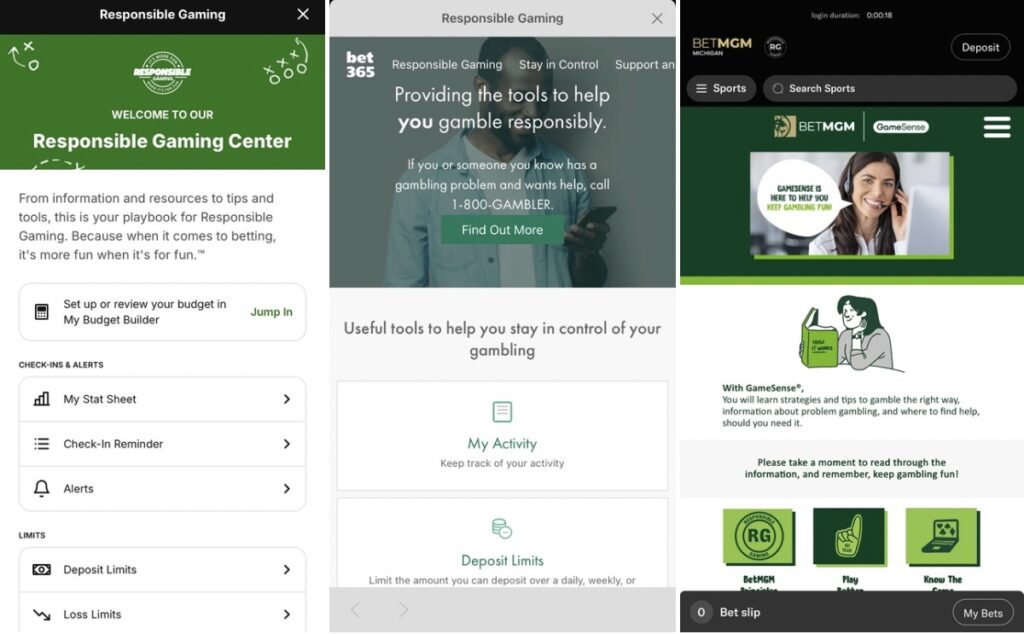
While there are consistent responsible gambling tools throughout the industry, each sports betting app has its own tools or features for responsible gaming.
Sportradar Technology Powering Responsible Gambling Tools
Sportradar is helping to power many of the responsible gambling tools that you find within your sports betting or online casino app.
Chief among those is Bettor Sense, an AI-powered player protection solution which helps identify early signs of problem gambling.
Some of the key capabilities of this software include:
- Personalized player profiling to analyze real-time and historical risk ratings
- Clear and actionable risk assessments
- Comprehensive dashboards to track trends
Recognizing Problem Gambling Signs
Everyone should gamble responsibly, but how do you know if you are no longer doing it safely?
Here are some problem gambling signs to watch out for:
- Chasing losses
- Being preoccupied with gambling
- Lying to family members or loved ones to hide the extent of your gambling
- Feeling restless or irritable when attempting to cut back on gambling
- Needing to increase the amount your gambling to get the same thrill
- Risking relationships or opportunities (jobs, school, etc.) because of gambling
If you, or a loved one, are experiencing any of these signs or symptoms of problem gambling, please use any of the resources listed on this page to get help.
National & State Support Resources
Wherever you are in the US, there are support options available for problem gambling.
National support resources include the following:
- National Council on Problem Gambling: The main national hub for problem gambling resources online, giving you access to help in various forms both in your community and online.
- 1-800-GAMBLER: The national hotline for problem gambling, allowing you to speak with a counselor and find help near you.
- GamTalk: An online peer support program through Evive.
- Gam-Anon: A self-help organization for family or close friends of compulsive gamblers.
- Gamblers Anonymous: A fellowship of people sharing their experience with each other to help each other recover from a gambling problem.
Some states have their own resources on top of the ones available at the national level. This includes states without legal gambling.
Each state also has its own self-exclusion list, which you can access through the various regulatory bodies that oversee gambling, like the New Jersey Division of Gaming Enforcement or the Pennsylvania Gaming Control Board. You can add your name to those list through your apps, or directly through the governing body.
Responsible Gambling FAQs
How do I put my name on a self-exclusion list?
You can add your name to the self-exclusion list on the betting app that you are using, or by contacting your state’s gambling regulator.
How do I remove a self-exclusion on DraftKings and BetMGM?
Typically you cannot remove your name from a self-exclusion list until the timeframe is over. This is a safety measure meant to protect you.
Are deposit limits reversible?
You can instantly decrease your deposit limits — as well as wager limits. You will often need to go through a cooling off period before you can increase those limits, however.
What happens to my balance if I self exclude?
If you self-exclude through a specific app, it must close your account and return any money you have in your account to you. You cannot withdraw from an account while on self-exclusion, though, without monitored assistance.
Can a spouse, relative, or friend add someone to a self-exclusion list?
No. A spouse or any other third party cannot add another person to a self-exclusion list.
Evergreen Writer/Editor; Sportsbook Expert
With nearly two decades of experience in sports media, Paul Costanzo turned his professional attention to sports betting and online gambling in January of 2022. He's covered every angle of the industry since then, managing and creating content for PlayMichigan and The Sporting News, and now SBD.