Prediction Markets Show Close Kansas Senate Odds for Midterms: Trade Elections on Kalshi
By Paul Lebowitz in Politics News
Published:
- Election Day, Nov. 3, is almost here, and the Midterms are a hot topic on prediction markets
- Kansas Senate odds have been trending, as the markets show nearly a dead heat ahead of the upcoming election
- Prediction platforms like Kalshi offer the chance for users to trade on who they think will win the Kansas Senate race
Kansas Senate odds have been trending as prediction markets for the midterm elections show a tight race in the Sunflower State. Given the realities of a midterm election, particularly one with a polarizing and historically unpopular president, it is no surprise that polling in many Senate races shows Democrats more competitive than normal.
The GOP is nearly assured of losing control of the House of Representatives. The Senate, for much of the past two years, was viewed as a best-case scenario for the Democrats. But with the Republicans leaking support, the Democrats are now favored to take the Senate and are competitive — to their amazement and suspicion that it can’t be real —in Kansas.
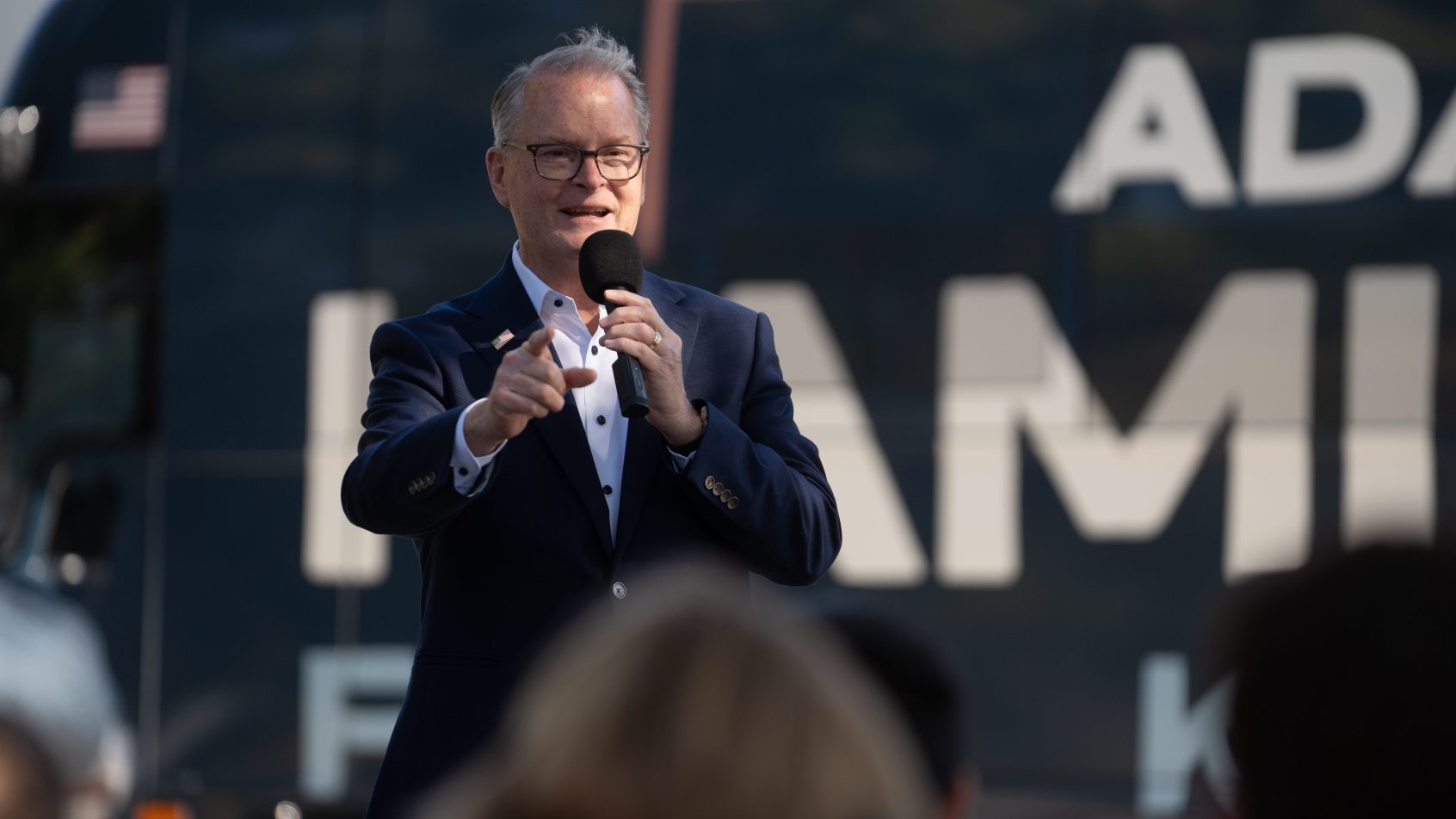
Sen. Marshall is a MAGA Republican completing his first term. Under any other circumstances, the Democrats would not even bother waging a fight in the Sunflower State. But Hamilton, who is a pastor and has many attributes that would play in Kansas if he had an “R” next to his name, is leading in most polls.
Given the general unreliability of polls in the Trump era, it’s very possible that the numbers are not just a little off, but a lot off. Still, the Democrats are wise to push the envelope and see if they can somehow go beyond the four seats they need to take control of the upper chamber and perhaps win in states they could never have imagined they’d even be within ten percentage points, let alone win. Prediction markets are watching the Kansas race closely, with a surprising number of users investing in a victory for Hamilton. Needless to say, this would be cataclysmic for Trump and the GOP.
Kansas State Odds Are Close as Election Day Approaches
Trading volume for this race is rising and is approaching $7 million.
Hamilton’s market probability is now in the low-50s. Marshall is in the high-40s. That it is close is amazing in and of itself. Hamilton leading is so flabbergasting that it is understandably eliciting “Is this real?” questions in a disbelieving tone.
For those who want to jump into this potentially lucrative market, the Kalshi promo code offers a sign up bonus for new users.
Adam Hamilton (D)
A Democrat, any Democrat, being competitive in a glowing red state like Kansas is mind-blowing. Hamilton holding a consistent lead in polling across the spectrum is understandably hard to believe.
When looking at the details and the metrics, it starts to make sense, at least on the surface. The only question investors need to ask before backing Hamilton is if they trust that it’s real.
Hamilton is 62 and has a deeply religious background in a deeply religious state. He’s not a Democrat espousing separation of church and state, pushing a socially liberal agenda, and touting his credentials as a Democratic Socialist, any of which would eliminate him as a matter of course. He went to Oral Roberts University and achieved a Master of Divinity from the Perkins School of Theology at Southern Methodist University.
His platform focuses on the economic needs of the statewide electorate; he is opposed to the Trump tariffs because they have hurt the once-thriving agriculture business in Kansas; and he has come out against data centers. He has not gone so far as to suggest there be what state residents would see as socialized medicine, but he has mentioned healthcare expenses and is seeking solutions for the problem. The only problem for him is he’s got a “D” next to his name. That could make the difference for many voters who cannot stomach voting for a Democrat either due to force of habit or an ingrained philosophical divide.
Roger Marshall (R)
In a Trumpless vacuum, Kansas would garner zero attention either by the media or on prediction markets. However, the president’s unpopularity has led to greater scrutiny of anyone and everyone connected to him, even in a peripheral way. There’s every chance that Trump doesn’t even remember Marshall’s name unless he’s reminded of it two minutes before pronouncing that every Kansan needs to vote for him.
Marshall is all in on MAGA, and while that was a boon in 2020 when he was first elected to the Senate, it is now a box he’s subtly trying to extricate himself from without alienating the hair-trigger Trump. His personality was irrelevant six years ago. Now that he needs to actively campaign and ask for people to vote for him instead of expecting it due to party affiliation and Trump’s imprimatur, his bad temper is showing itself. He is not a smooth candidate because he never needed to be one. The healthcare issue and its costs are a profound negative for him since, in his pre-political career as an OB-GYN, he sued patients for non-payment, with some even ending up in jail after failing to appear in court. He has faced accusations of financial impropriety in his campaign.
Regardless, it is impossible to quantify the state’s heavy conservative base, and the last Democrat elected to the Senate from Kansas was George McGill in 1932. For context, that year, the still adolescent NFL had teams called the Portsmouth Spartans, the Boston Braves, the Brooklyn Dodgers, and the Staten Island Stapletons.
Kansas does not elect Democrats for national office. But Gov. Laura Kelly is a Democrat. For her to win, some Republicans and Independents must have voted for her. They could also vote for Hamilton.
The safe pick is to expect a regression to the mean. Polling and prediction markets are sanguine about Hamilton’s chances. But history says something else entirely, and it’s still probably Marshall’s race to lose. He won by over 11 percentage points in 2020. This race might be closer, but not so close that it was ever really in doubt to begin with.
Paul Lebowitz is a novelist, columnist, social commentator, and the author of eight published books on baseball – one novel and seven baseball guide/previews. He covers sports, politics, and pop culture. Paul graduated from Hunter College with a degree in English. He lives in New York City.