Sabalenka vs Osaka Picks, Predictions & Lines

By Juan Pablo Aravena in Tennis
Published:
- Sabalenka has dominated her draw, conceding just 18 games across three straight-set victories with a 55.2% break-point conversion rate
- Osaka has been stretched in every round, requiring tiebreakers in all three matches and going to three sets in R3 – a significant workload disadvantage
- We believe Sabalenka will cover the -4.5 spread (-138) while seeing the game hit the Under in 20.5 total games (-120)
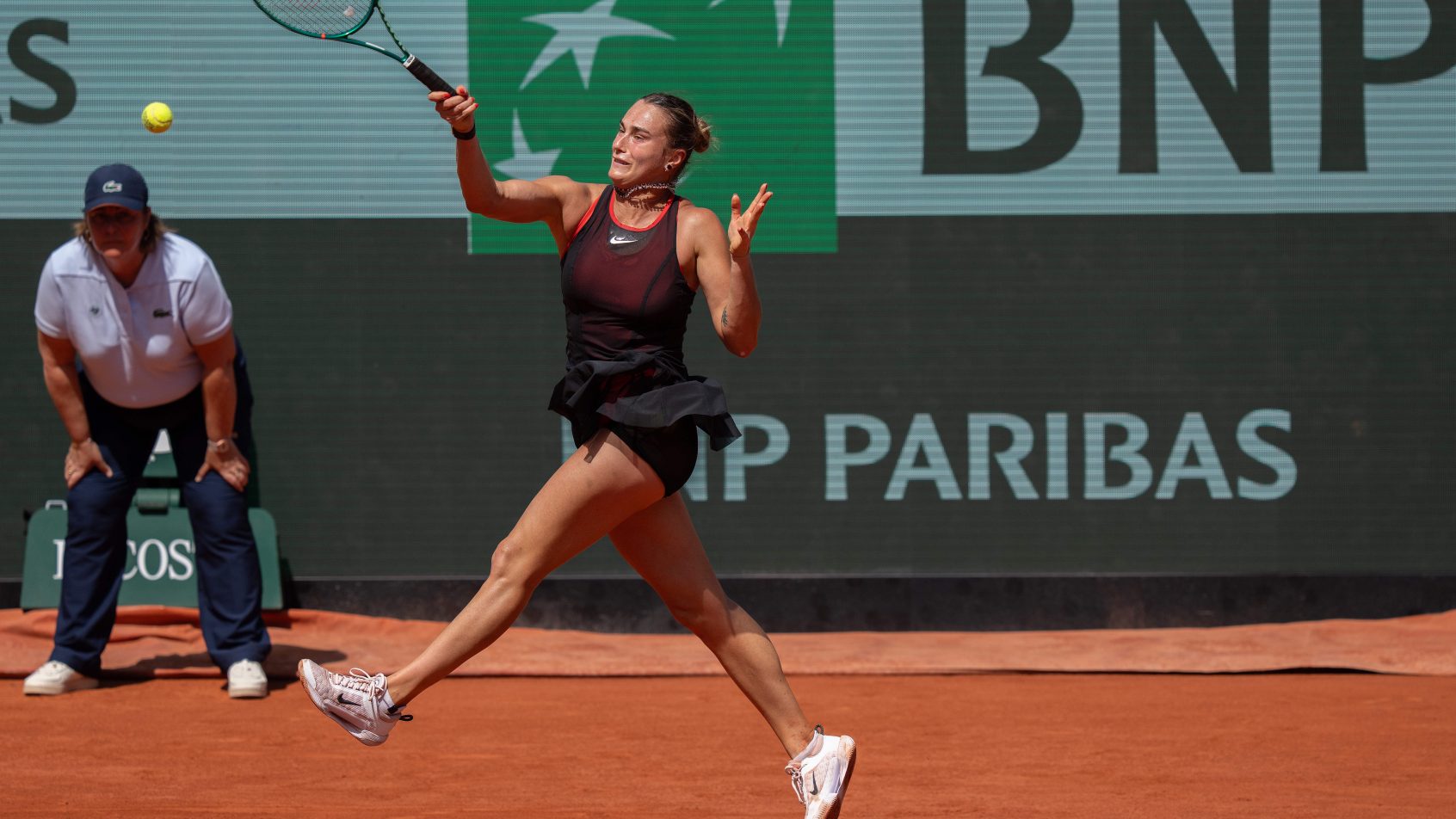
The stakes are monumental for this Round of 16 clash at the French Open Women’s Singles tournament, as world No. 1 Aryna Sabalenka squares off against No. 16 Naomi Osaka. Scheduled for June 1, 2026, at 2:15 PM ET on the iconic Court Philippe Chatrier, this matchup pits a heavy betting favorite against a high-profile underdog.
Sabalenka enters Roland Garros looking to solidify her absolute dominance atop the WTA Rankings, while Osaka desperately needs a signature upset to catapult her back into the elite echelon of major contenders.
Crucially, their tournament paths tell vastly different stories: Sabalenka has bulldozed through her draw without dropping a set (6-4, 6-2 over Bouzas; 7-5, 6-2 over Jacquemot; 6-0, 7-5 over Kasatkina), while Osaka has been pushed to tiebreakers in all three rounds and needed three sets to survive against Iva Jovic in R3 (7-6, 6-7, 6-4).
From a pure handicapping perspective, I am looking to exploit the stark contrast in baseline aggression, break-point efficiency, and physical workload between these two players. In this breakdown, I will isolate the most mathematically sound betting angles, avoiding emotional narratives to focus strictly on underlying situational data and recent clay-court performances.
My primary actionable picks for this match are backing Aryna Sabalenka -4.5 games at -138 and the Under 20.5 total games at -120 (both via bet365). Both angles are strongly supported by the tournament data profiles of these two players and their recent head-to-head history.
Sabalanka vs Osaka Picks & Predictions
Both angles are strongly supported by the tournament data profiles of these two players and their recent head-to-head history.
Let’s break down the data behind these projections. Sabalenka is currently operating at an elite baseline efficiency, commanding the undisputed world No. 1 ranking with 9,960 points. Through three rounds at Roland Garros, Sabalenka has won 203 total points to her opponents’ combined 157, posting a staggering +46 point differential while conceding just 18 games across six sets.
Her game margins this tournament have been decisive: +6 against Bouzas (12-6), +6 against Jacquemot (13-7), and +8 against Kasatkina (13-5) — covering the -4.5 spread in every single match.
Her break-point conversion this tournament sits at a blistering 16-of-29 (55.2%), while her opponents have converted just 6-of-14 break chances against her — meaning she holds serve at an elite rate even under pressure. She’s committed only two double faults across three matches, demonstrating the kind of serving discipline that suffocates opponents on clay.
The spread is further reinforced by the head-to-head data. In their two 2026 meetings, Sabalenka covered -4.5 games in both: she won 12-6 in games at Indian Wells (6-2, 6-4) and 18-12 in games at Madrid (6-7, 6-3, 6-2) — a +6 margin even in a three-set match where she dropped the opening set in a tiebreaker.
Across five relevant data points (three tournament matches plus two H2H meetings), Sabalenka has covered -4.5 in all five. Her dominance in break-point generation — 14 break-point opportunities in Madrid versus Osaka’s one, and nine at Indian Wells versus Osaka’s two — illustrates the structural mismatch on the return side.
Osaka, by contrast, has faced far greater resistance through her three rounds. Despite winning all three of her matches, she required tiebreakers in every single round and was extended to a grueling three-set battle against 17-year-old Iva Jovic in R3 (7-6, 6-7, 6-4), logging 224 total points in that match alone.
Her cumulative workload of 277 points won across 45 games played (versus Sabalenka’s 203 points won in just 38 games) represents a significant physical expenditure heading into this fourth-round clash.
Sabalenka’s 55.2% break-point conversion rate means she is not simply holding serve and waiting for tiebreakers — she is actively breaking to shorten sets. While Osaka has produced 21 aces across three rounds (including 12 against Jovic), showing that her first serve remains a genuine weapon, that power hasn’t translated into comfortable holds or the ability to extend sets against elite-level opponents.
Sabalenka’s ability to attack Osaka’s second serve — where the Japanese star has won as few as 41% of points — should create frequent break opportunities and prevent the drawn-out tiebreaker scenarios that characterized Osaka’s earlier rounds.
Summary of Picks:
- Sabalenka -4.5 games at -138 (bet365) — covered in all 5 relevant data points (3 tournament matches, 2 recent H2H meetings).
- Under 20.5 total games at -120 (bet365) — Sabalenka’s tournament average is 18.7 total games per match, and her straight-set win over Osaka at Indian Wells produced just 18.
French Open Odds: Sabalenka vs Osaka
Moneyline pricing Kalshi. Spread and Total Games pricing from bet365. All odds are subject to line movement prior to the first serve.
Sabalenka vs Osaka H2H History
Aryna Sabalenka enters this French Open showdown holding a 2-1 advantage over Naomi Osaka in their all-time head-to-head history, including a clean 2-0 record in 2026. Their first-ever meeting came at the 2018 US Open, where a then-20th-seeded Osaka defeated the 26th-seeded Sabalenka 6-3, 2-6, 6-4 — a result from an entirely different era for both players. However, Sabalenka has won the subsequent four head-to-head meetings (including exhibitions) since that loss.
The defining statistical narrative across their recent matches is Sabalenka’s overwhelming ability to generate break points and dictate rallies from the center of the court. In Madrid, despite dropping the opening set in a tiebreaker, Sabalenka systematically broke down Osaka’s defenses, clearing a +13 margin in break-point opportunities (14 to 1) and successfully converting four.
Across their two meetings this season, Sabalenka has significantly outpaced Osaka in total points won, posting a dominant 183 to 147 ratio. This volume of point generation highlights the severe uphill battle the Japanese star faces in attempting to neutralize the heavy topspin and baseline power of the world No. 1 on a slow clay surface.
The tournament workload disparity adds another critical layer. Sabalenka has spent just 38 games on court across three rounds, winning her 106 service points while committing only two double faults and maintaining first-serve win percentages of 68%, 68%, and 73%.
Osaka has played 45 games while conceding 36 to her opponents, served seven double faults, and seen her first-serve win percentage rise from 75% to 79% across the tournament — solid numbers, but paired with a second-serve vulnerability (61%, 41%, 53%) that Sabalenka is uniquely equipped to exploit.
Combined with Osaka’s 37.5% break-point conversion rate versus Sabalenka’s 55.2%, the mathematical profile overwhelmingly favors the world No. 1 to control this match from the opening game.
Juan Pablo is a sports writer and betting analyst with over 15 years' experience in the industry. He is an expert in European and Latin American soccer, as well as NBA, MLB, NHL, NFL, college sports, and EuroLeague. He was born and raised in Chile and is fluent in Spanish, English, and Portuguese.