NASCAR DFS Picks – Brickyard 400 Projections, Lineup & Strategy
By Phil Bobbitt in Racing
Published:
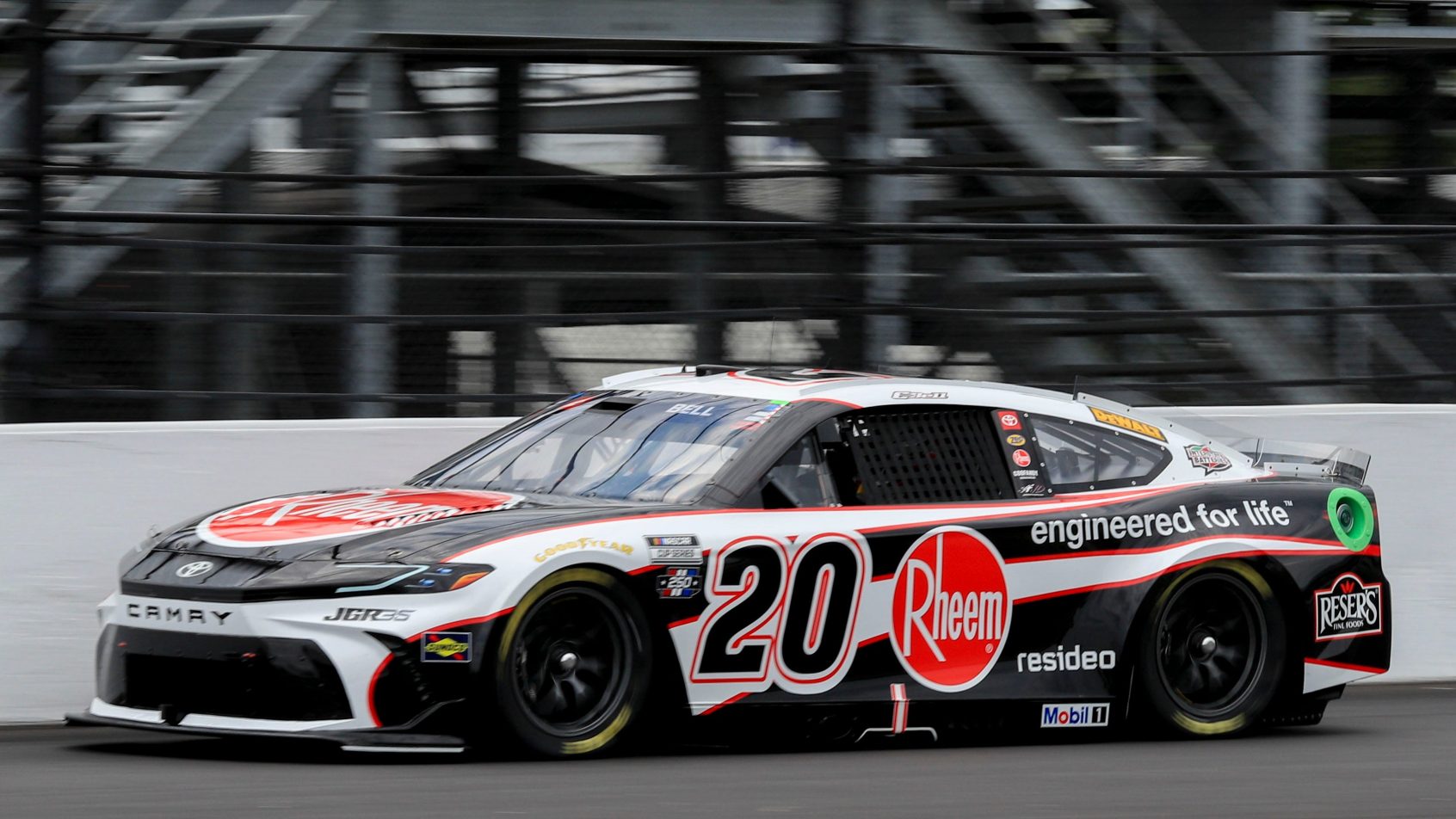
- Two models identify major value deep in Sunday’s field.
- The second-ranked SS2 practice driver starts 23rd.
- Brickyard 400: Sunday at 2 p.m. ET on TNT.
Indianapolis Motor Speedway has four distinct corners, two enormous straightaways and absolutely no interest in making anyone comfortable.
Track position matters, passing becomes difficult near the front and one poorly timed caution can turn a brilliant strategy into something normally found inside a gas-station trash can. Sunday’s 160-lap Brickyard 400 presents a fascinating DraftKings puzzle.
Our lineup combines three major place-differential targets with aggressive bets on Tyler Reddick and Corey Heim maintaining their starting positions. Christopher Bell supplies the strongest overall combination of practice speed and differential, while Todd Gilliland gives us the salary relief needed to fit everything together.
The Brickyard 400 begins Sunday at 2 p.m. ET on TNT.
Brickyard 400 Lineup
Brickyard 400 Strategy
Christopher Bell ($10,000)
Bell starts 23rd despite recording the second-best SS2 practice metric in the field. Unlike the traditional practice leaderboard, the proprietary metric evaluates the complete body of work from Friday’s session instead of relying on one fastest lap.
The same metric proved predictive of Saturday’s O’Reilly Series race pace, increasing our confidence in its Cup conclusions.
Bell also led the traditional single-lap practice chart, but his sustained speed is the important part. Both projection models expect him to recover, with one placing him at 10.37 and the other projecting 8.46. Their average gives Bell an expected finish of 9.42 and nearly 14 positions of positive differential.
Bell owns the best combination of floor and ceiling in the lineup. He should not remain 23rd for long. If he does, we will quietly close the practice workbook and tell everyone we were watching the Phillies.
Todd Gilliland ($5,900)
Gilliland starts 36th and provides the salary relief needed to roster Bell, Reddick and Wallace.
His practice performance was poor. Gilliland ranked 34th in the proprietary SS2 practice metric, so we are not expecting him to blast through the field like someone installed a secret Hendrick engine overnight.
This selection is about positional protection and price. One model projects Gilliland to finish 29.98, while the other places him at 21.86. Even the more pessimistic projection gives him approximately six positions of improvement.
Gilliland needs to survive, pass the part-time entries and collect positions as Indianapolis begins eating race cars. At $5,900, we are not asking him to kiss the bricks. We would settle for him seeing them clearly through the windshield.
Corey Heim ($8,100)
Heim starts seventh and represents one of the lineup’s most interesting tournament selections.
The projection models disagree dramatically. One has him finishing 20.35, while the other projects him at 5.89. The proprietary SS2 practice metric supports the optimistic side of that argument, ranking Heim fifth in the field. His seventh-place qualifying effort was not the only indication of competitive speed.
Heim will also drive the same 23XI Racing equipment that put Reddick third on the grid and carried Wallace to victory in last season’s Brickyard 400.
He carries considerable negative-differential risk, but his practice performance gives him a legitimate opportunity to remain near the front. At $8,100, a top-10 finish works. A top-five run could separate the lineup.
The models place Heim at 5.89 and 20.35. We split the difference and purchased antacids.
Ryan Preece ($6,700)
Preece starts 34th and provides one of the safest place-differential profiles available.
The practice metric ranked him only 24th, but he does not need front-running speed to justify his salary. One model projects Preece at 22.80, while the other has him at 17.04. Their average projection of 19.92 represents approximately 14 positions gained.
Preece also brings more organizational strength than most drivers priced in this range. A finish around 20th would make him useful, while a clean run into the top 15 could make him one of the slate’s best values. A victory would make us insufferable until at least Wednesday.
Tyler Reddick ($10,200)
Reddick starts third and is our primary dominator candidate.
His SS2 practice metric ranked 13th, which is less impressive than his starting position. The projection models also disagree, placing him at 3.81 and 12.16. We are siding with the more optimistic result because Toyota demonstrated excellent speed throughout Friday’s session.
Reddick starts behind Carson Hocevar and Daniel Suarez, two drivers with weaker long-run projections. That gives him an opportunity to take the lead early without paying Denny Hamlin’s $11,000 salary.
We need laps led and fastest laps because Reddick cannot rely on differential. If he reaches the lead, Indianapolis becomes considerably easier when everyone else is trapped in traffic behind him.
If Reddick reaches the lead early, we are cooking. If he settles into fourth for 160 laps, the television may begin hearing language not approved by TNT.
Bubba Wallace ($9,000)
Wallace returns as the defending Brickyard 400 winner but starts 29th after scraping the wall during practice.
His SS2 practice metric ranked only 28th, so this selection is driven more by track history, equipment and place differential. One model projects Wallace at 15.52, while the other gives him considerably more upside at 6.73. Their average of 11.13 creates nearly 18 positions of expected improvement.
Wallace does not need to defend his victory to become a strong DFS play. A top-15 finish provides value, while another charge near the front could break the slate.
Final Analysis
Bell’s second-place SS2 practice ranking makes him the foundation. Heim’s fifth-place ranking supports his top-10 starting position, while Reddick supplies dominator potential. Wallace, Preece and Gilliland can accumulate points simply by moving through the field.
If it works, we will call it a carefully balanced tournament construction. If Heim falls backward and Reddick never leads, we will blame the yard of bricks. They have been sitting there looking suspicious since 1909.
Phil Bobbitt is a motorsports betting analyst and recurring guest on CBS Sports HQ, The Early Edge, and VSiN’s A Numbers Game. He and his pal Steve developed a racing algorithm that’s profited over 260 units and $1 million in DFS winnings since 2020.